
Introduction: The Local Search Reality of High-Ticket Dentistry
For elective, high-value clinical treatments—such as full-arch dental implants, guided bone regenerations, and clear aligner therapies—the patient journey rarely begins with a cold referral or a billboard. Over 80% of prospective patients searching for life-changing dental procedures begin on Google, and the decisive touchpoint is almost always the Google Maps Local 3-Pack.
When a patient faces tooth loss or complex aesthetic malocclusion, their search intent shifts dramatically. They are no longer searching for routine dental hygiene; they are seeking surgical authority, clinical safety, and local proximity.
Simply having a verified Google Business Profile (GBP) is no longer enough. To capture high-intent inquiries over competing corporate dental chains, private practices must treat their local search presence as an active, calibrated clinical asset.
1. The High-Value Search Shift: Intent Mapping & Keyword Nuance
Generic search queries like “dentist near me” or “dental clinic in [city]” typically capture routine preventive checkups, cleanings, and emergency toothaches. While essential, these low-friction visits rarely generate substantial practice growth.
In contrast, patients seeking complex restorative or orthodontic solutions search with high commercial intent:
-
“Best dental implant specialist in [suburb/city]”
-
“Full mouth dental implants cost near me”
-
“Clear aligners certified provider [neighborhood]”
-
“CBCT guided implant surgery [city]”
Algorithmic Relevance vs. Proximity
Google’s local ranking algorithm weighs three core pillars: Relevance, Distance (Proximity), and Prominence.
While proximity is constrained by geography, Relevance and Prominence can be systematically engineered. When your profile explicitly demonstrates surgical capability and digital workflows, Google’s local search algorithm prioritizes your practice across an expanded geographic radius, overcoming strict physical proximity limits.
2. Google Business Profile Optimization: Surgical Precision Setup
A default listing with basic hours and phone numbers leaves the algorithm guessing. To rank for high-value treatments, your profile configuration must be granular and aligned with clinical terminology.
Primary vs. Secondary Categories
Your Primary Category carries up to 60% of your profile’s contextual ranking power. Setting it to generic “Dentist” forces your listing to compete with hundreds of general clinics for routine searches.
-
Recommended Primary Category: Set to your highest-value clinical focus (e.g.,
Dental ClinicorDentistif offering broad care, but strategically utilizeDental Implants Periodontist,Cosmetic Dentist, orOrthodontistwhere applicable). -
Mandatory Secondary Categories: Populate up to 9 secondary categories to capture surgical and specialized searches:
-
Dental Implants Provider -
Orthodontist -
Oral Surgeon/Oral and Maxillofacial Surgeon -
Emergency Dental Service -
Teeth Whitening Service
-
Detailed Services Menu Architecture
Do not rely on auto-suggested service names. Create custom, detailed service entries under each category with 300-word clinical descriptions:
-
“All-on-4 / All-on-X Full Arch Implants” (mention 3D CBCT pre-planning, immediate fixed temporaries, and bone-preservation protocols).
-
“Computer-Guided Implant Surgery” (highlight minimal flap incisions, digital surgical guides, and biological stability).
-
“Digital Clear Aligner Therapy” (outline 3D optical scanning, biomechanical staging, and attachment design).
Weekly Clinical Updates & Real Photography
Google measures profile activity and freshness. Static profiles drop in prominence:
-
Weekly Google Posts: Publish weekly clinical highlights detailing recent technologies (e.g., introducing dynamic navigation, intraoral scanners, or autologous PRF protocols). Include an explicit call to action:
Call NoworBook Online. -
Clinical Photography: Replace stock stock-photo imagery with authentic clinic visuals—your actual sterilization suite, 3D surgical guide planning workstations, digital impression scanners, and team consultations.
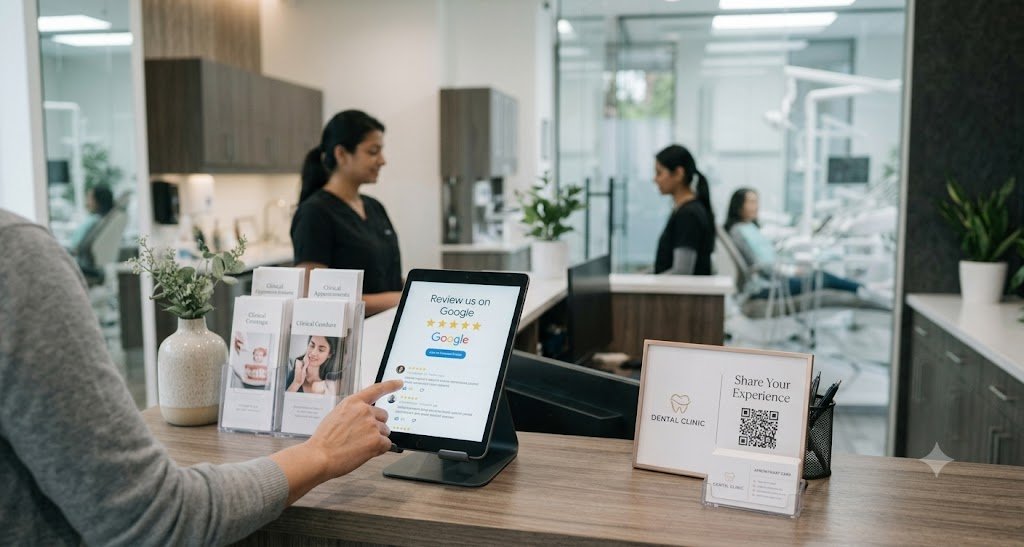
3. Review Architecture: Ethically Harvesting High-Intent Keywords
Google’s Natural Language Processing (NLP) algorithm constantly crawls patient reviews for contextual keywords. A clinic with 200 reviews that say “Nice clinic and friendly staff” will consistently lose rankings to a clinic with 50 reviews that say:
“Dr. [Name] placed two dental implants using a 3D digital guide. The procedure was painless and the healing was fast. Outstanding implant surgeon.”
The “Treatment-Specific” Review Workflow
-
Timing the Request: Never ask for a surgical review the day of the procedure. Request feedback during the provisional seat-in, suture removal, or definitive restoration appointment when the patient is genuinely thrilled with their functional outcome.
-
Review Prompting with Clinical Prompts: When sending automated SMS or WhatsApp review links, include friendly guiding questions:
-
“What procedure did you have completed (e.g., dental implant, clear aligners)?”
-
“How did our digital 3D planning or gentle approach make you feel during treatment?”
-
“Which neighborhood or city did you visit us from?”
-
-
Optimized Doctor Responses: Always respond to every review within 48 hours. Integrate natural clinical keywords in your response:
-
“Thank you for your trust, [Patient Name]! Our surgical team is delighted that your computer-guided implant healed smoothly. We are proud to provide advanced digital dentistry here in [City].”
-
4. Local Signals & Citations: Building Unshakable Medical Prominence
The third pillar of Google Maps dominance is Prominence—proving to search engines that your practice is an established, reputable healthcare institution across the broader web.
Absolute NAP Consistency
Your Name, Address, and Phone Number (NAP) must be identical across every public directory and digital platform:
-
Inconsistent abbreviations (e.g., “St.” vs. “Street”, or omitting suite numbers) create algorithmic ambiguity, eroding local ranking confidence.
-
Sync your data across premier healthcare directories, local business portals, Apple Maps, Bing Places, and social channels.
On-Page Geo-Targeted Architecture
Your Google Business Profile and website must work as an integrated unit:
-
Dedicated Surgical Landing Pages: Each core high-ticket service must have a standalone landing page (e.g.,
/services/implantology/) linked directly from the corresponding GBP service listing. -
Local Schema Markup (JSON-LD): Embed structured data schemas on your website connecting your exact coordinates, geo-radius, accepted insurances, and medical specializations (
Dentist,MedicalSpecialty,MedicalProcedure). -
Embedded Google Map & Clinical Case Summaries: Embed your verified GBP map pin on your contact page and showcase anonymized pre-op to post-op case records paired with local suburb tags.
Summary Checklist: Rank #1 for High-Ticket Dentistry
| Action Item | Frequency | Strategic Objective |
| GBP Categories Audit | Quarterly | Maintain alignment with high-value surgical categories |
| Weekly Clinical Posts | Weekly | Signal freshness, educate on 3D technology & surgical guides |
| Targeted Review Collection | Ongoing | Acquire keyword-rich patient reviews mentioning implants & aligners |
| NAP & Citation Audit | Bi-annual | Ensure 100% NAP consistency across healthcare directories |
| Website Local Schema (JSON-LD) | One-time / Updated | Provide machine-readable local medical data to Google crawlers |
Partner with Hanuka to Elevate Your Practice
Clinical excellence and digital practice growth go hand-in-hand. Through the Hanuka Clinical Alliance, we not only mentor your team chairside through complex implantology, bone augmentation, and digital aligner cases, but also help partner clinics position their expertise locally to attract and retain high-value patients.
Ready to transform your practice into a leading surgical center? Connect with our clinical alliance team today.
